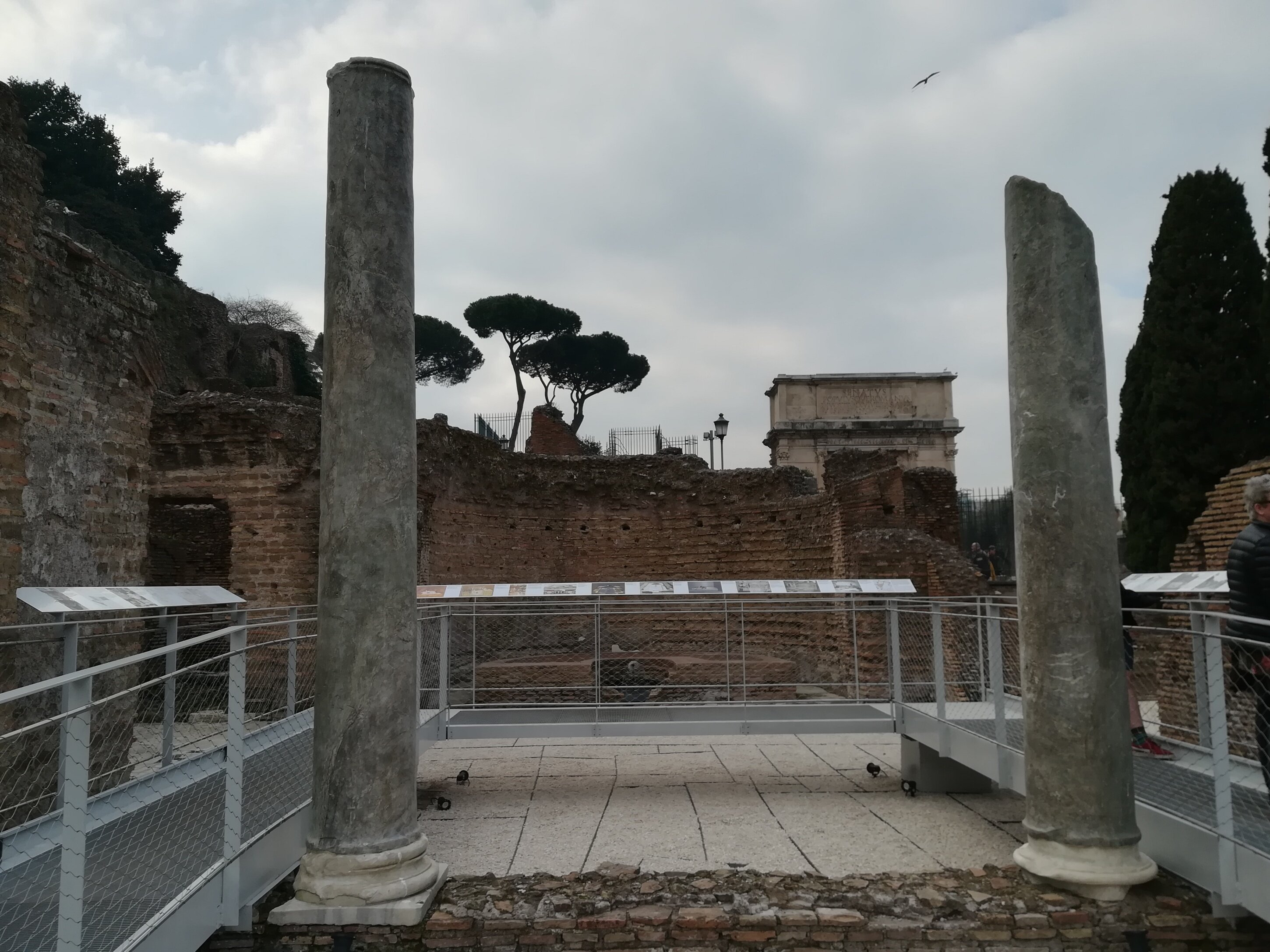
Today I would like to talk about something that no longer exists, about a temple built close to the Capitoline Hill in the Roman Forum (behind the Rostra), and of which today only very little archaeological evidence remains. After all, the political, religious and social center of the ancient city is also this, a place of memories and disappeared buildings of which, at times, only very few remains remain other than the historical memory through written sources. But as a local tour guide, here today I want to talk to you about a building which, in a certain sense, marked an entire historical period and a social compromise with which an attempt was made to stabilize Rome and its society. I'm talking about a temple that marked a first historical turning point in Roman politics and law: the Temple of Concord.
Built in 367 BC at the behest of Lucio Furio Camillo, the name clearly shows how the sacred building was erected to establish a renewed harmony in Roman society. What happened in that fateful year of 367 BC? A law was passed by the Senate of Rome, a law which took the name of Leges Liciniae Sextiae (from the names of the two tribunes of the plebs who promulgated it, Gaius Licinus and Lucius Sextius). What did this law sanction? The fact that plebeians could also run for the office of consul, the highest magistracy of republican Rome. In the wake of the centuries-old clash between patricians and plebeians, between two social classes that together contributed to governing well and increasing the Roman community, from the beginning, a special attention was paid to the patrician and aristocratic families who, with their wealth and assets, they could lend a great hand to Rome in case of need (especially by replenishing the state coffers and the army). But the plebeians also wanted their share of power, actively having the possibility of being able to decide the fate of Rome, especially from a political and administrative point of view. And it was precisely with this law that, for the first time, it seems that the Romans accepted that, if elected, they could see a consul from the less wealthy classes of Roman society. Obviously this is a simplification of what were the complicated mechanisms within the culture and politics of the city of the time. Even the classic distinction between optimates and populares, which theoretically could be seen as the two political factions expressing the patricians and the plebeians, was not as clear as one might think. However, as in some ways happens even today, a law can mark, at least from a political and legislative point of view, a real watershed. Equally obvious was also the adventurous life of the temple, destroyed, rebuilt, embellished or renovated many times over the centuries. Remember, for example, a sentence by Suetonius ( “With the proceeds of the spoils of war he restored the temple dedicated to Concordia, as he did for that of Castor and Pollux, in his own name and that of his brother”), referring to Tiberius (we are, therefore, in the 1st century AD). The position of the temple was a bit awkward, as it was framed by the Capitoline Hill behind it, with the large mass of the Tabularium acting as a bit of a block, and with subsequent temples built over the years, such as that of the Divo Vespasian, for example. A temple that is certainly prestigious, if we consider the historical events that took place here, such as one of the famous orations that Cicero (which you can read something about by clicking here) made against Catiline.
Here, therefore, are some of the meanings of Concordia, linked, inextricably, to that harmony achieved (despite having subsequently been constantly put to the test) after more than 150 years of class struggles. It should also be added that the remains found today near the Capitoline Hill belong to the reconstruction, in more sumptuous forms, of the Temple of Concord commissioned by Augustus and Tiberius. Few, very few remains, unfortunately. In 1817, following excavations, portions of the polychrome floor, some marble reliefs and friezes were found. Something magnificent which, in one way or another, tells us how the Romans attempted, at least in words if not in deeds, to rediscover that much desired harmony...