

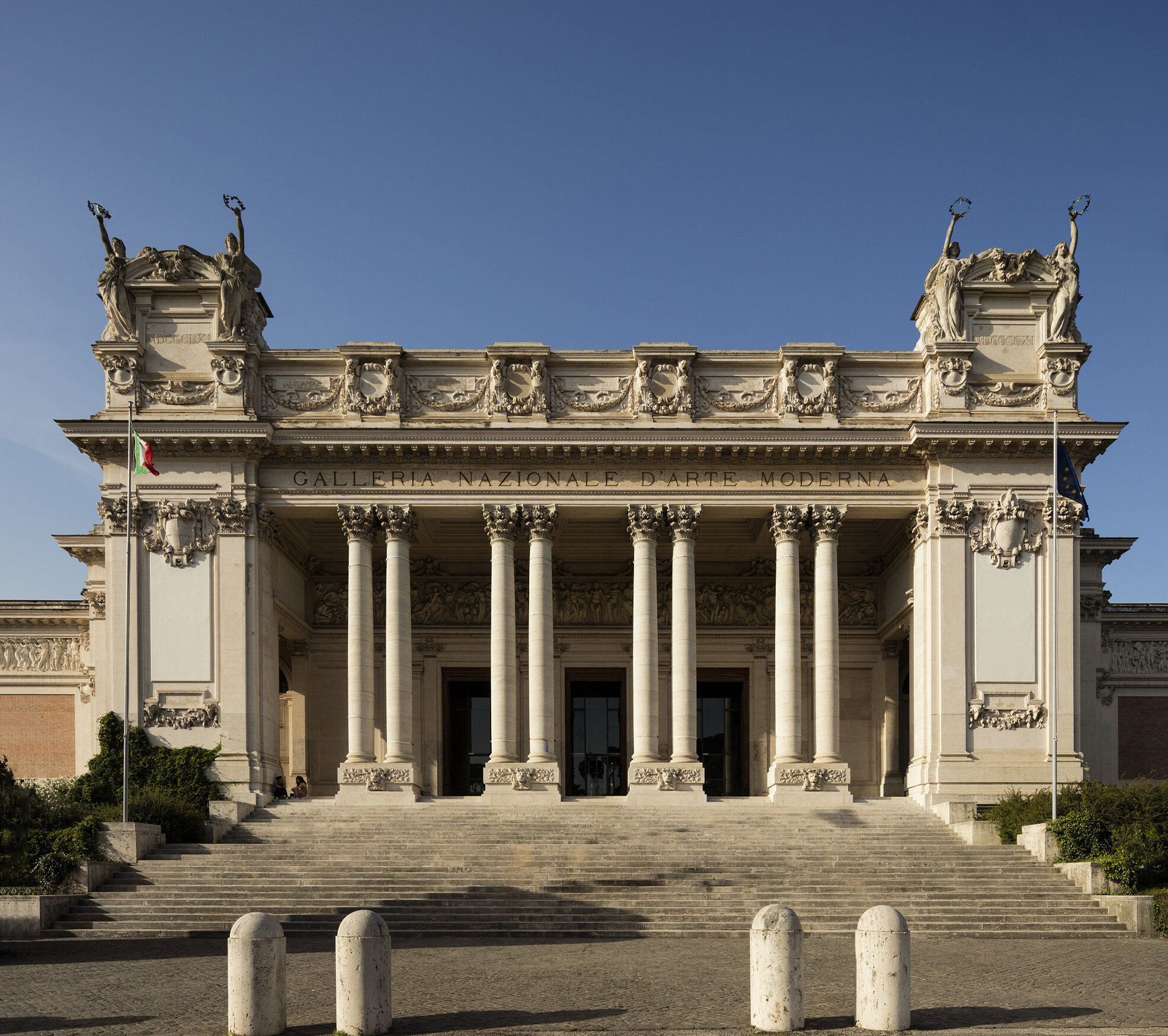
This is the impressive facade, with pronaos and paired columns on the front, of the National Gallery of Modern Art in Rome. In addition to being a magnificent museum that houses thousands of works of art (such as the copy of a famous masterpiece by Duchamp or a canvas by Pollock) ranging from the late nineteenth century to the 1960s and beyond of the twentieth century, this is a true Roman institution, a symbol of how the Eternal City can continually regenerate itself, without necessarily having to depend solely and exclusively on its incredible and ancient past. As your tour guide in Rome, therefore, today I will clarify some details about one of the modern aspects of the Eternal City, something perhaps less known but which deserves further exploration.
The genesis of the National Gallery of Modern Art dates back to 1883, when the new Rome, Capital of the Kingdom of Italy, according to the vision of the Kings, was to host a museum where Italians could admire the works of their contemporaries. As if to say that Rome, rightly, is not only ancient or Renaissance age. It is curious, however, to know that the first location of this museum was the Palazzo delle Esposizioni, also built in those turbulent years when the face of Rome changed radically. Then, however, the collection grew year by year and, especially on the occasion of temporary exhibitions, organizational problems began to arise. So they began to look around for a new location, and the opportunity came in 1911 when Rome wanted to organize the International Exhibition for the 50th anniversary of the Unification of Italy. A golden opportunity to give the city a new look, with new construction sites opening and new projects being launched. After all, Rome thrives on even global events, just think of this year's Jubilee, events that bring new funds which allow the city to renew itself. It was especially the area of Valle Giulia that was affected by reclamation and works, such as the construction of the current building housing the National Gallery of Modern Art, also known as the Palace of Fine Arts. The project was by the Roman architect and engineer Cesare Bazzani (the same author of the Ministry of Public Education on Viale Trastevere in Rome and the Fatebenefratelli hospital on Tiber Island). In 1933, even this building became insufficient to accommodate all the works that had arrived in the gallery by purchase or donation. Again, Cesare Bazzani designed and inaugurated in that year an extension that doubled the exhibition space (this corresponds to the rooms currently occupied by twentieth-century works). It's incredible how, if you think about it, it was almost impossible to find a suitable venue to house works that, by their very contemporary nature, increased day by day. Years passed until the catastrophe arrived: it was 1941, in the midst of World War II. The works, like all of Rome, would soon be threatened by bombs, the Nazis, or who knows what other dangers. Fortunately for us, that year Palma Bucarelli, not yet thirty, became superintendent of the Gallery, a position she held for over 30 years until 1975. She is credited with an important modernization of Italian culture and an openness to the most modern international experiments. She worked to equip the Gallery with all those facilities that are now considered essential for a modern museum: educational services, library, cafeteria, bookshop, book presentations, meetings with artists. There were also social events such as fashion shows. On the one hand, she truly made what had become an institution in Rome modern, and not just a museum. But on the other hand, Bucarelli was fundamental in saving the works from the war. She was the one who organized secret transports to take the works to the Farnese Palace in Caprarola (in the province of Viterbo, on Lake Vico), then to Castel Sant'Angelo.
As you can imagine, therefore, sometimes you also need the right people in the right place, as well as at the most opportune moment. A real stroke of luck for us, since for decades now the National Gallery of Modern Art has been a cornerstone of local and national culture, with many works of art that help to deepen our understanding of the artistic trends closest to us, and which have already made history. Do you see how fascinating the history of a relatively recent building can be? Rome always surprises...





















