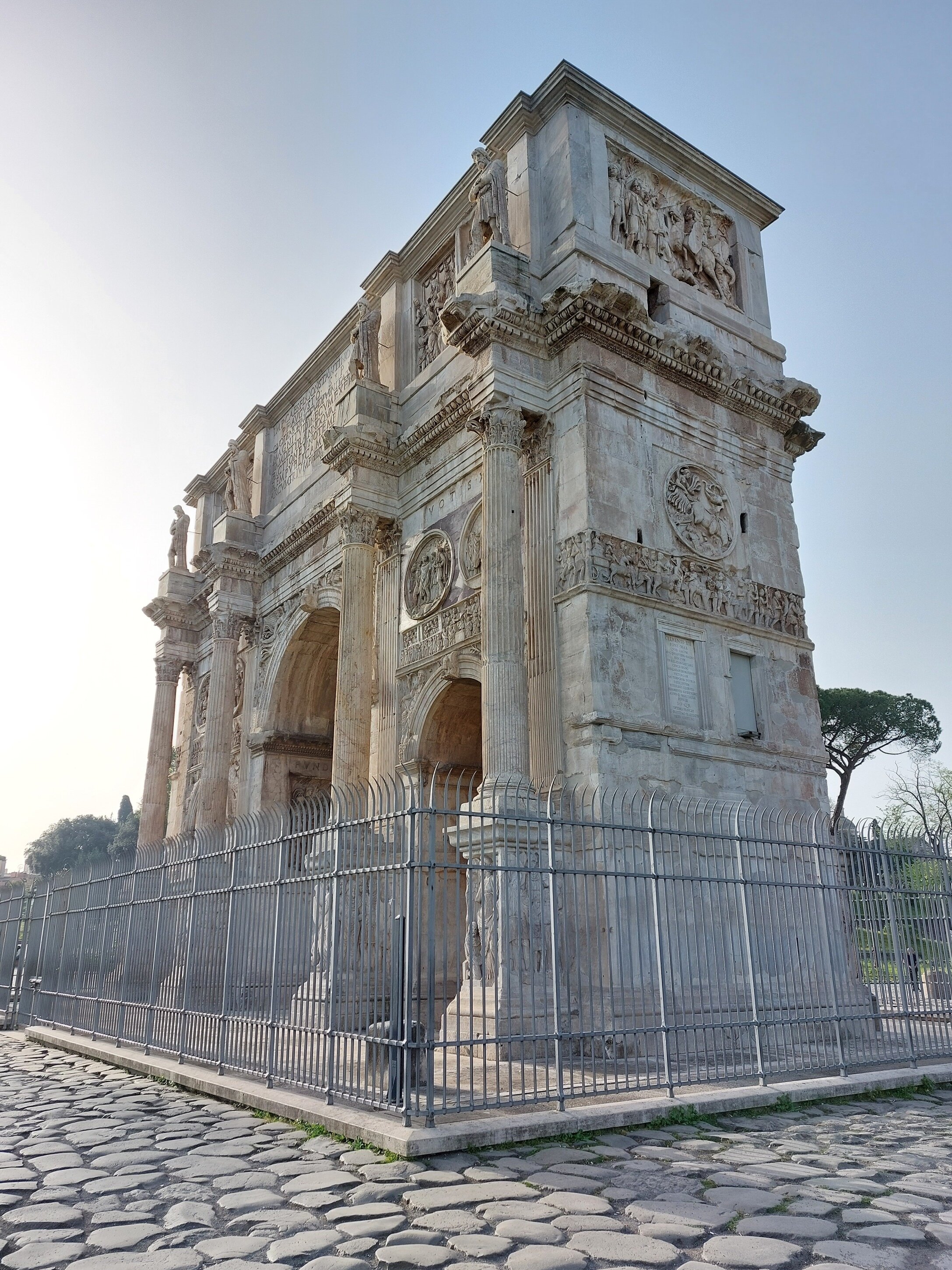
Here for you is the Arch of Janus, a tetrapylon arch, that is, provided with four arches and four passageways, made of marble and travertine and located near the Church of San Giorgio al Velabro and the nearby, and curious, Arch of the Argentarii. For all intents and purposes, in my view, one of the symbols of antiquity in Rome.
You can see a series of niches that were once filled with marble statues. This extraordinary monument, the only example of its kind in Rome, most likely served as an entrance to the Forum Boarium area, the ancient meat and livestock market of Rome, established in the city as early as the time of the kings. But if the area was indeed archaic, ancient even for the Romans themselves, the Arch of Janus actually represents an architectural monument of that imperial age that would later lead to the end of the Western Roman Empire. The Arch of Janus was in fact erected in the 4th century AD in the time of Constantius II, son of Constantine. When the latter died, the empire was divided among his three sons who later fought among themselves. Constantius II was, among the three, the one who withstood ambushes and wars, eventually becoming, just as his father did, master of the whole Empire. Aside from this, however, it is interesting to underline the intense life of this particular monument, set in an iconic place in Rome (nearby, in fact, the basket with the little Romulus and Remus would have snagged and then been found by a she-wolf, as you can read here). Beyond the myth, though, the Arch of Janus also tells us how the Eternal City can transform its monuments, without them, in some cases, suffering major damage. During the Middle Ages, in fact, the Frangipane family (among the most prominent and powerful family clans about eight centuries ago) had the audacity to claim the Arch of Janus as their own, and it effectively became their private property. They had no qualms, as they did with the Colosseum, about fortifying the four-fronted arch, adding an attic and closing off the passageways. For some time, therefore, the Arch of Janus was, for all intents and purposes, a small fortress...
The Arch of Janus was not only an entrance, but also a covered area useful on rainy days and for doing business in the cool and, also, a bit out of sight. Janus was Rome’s two-faced god, a native deity who represented beginning and end, good and evil, peace and war. In short, all the opposites of our existence. Not by chance the month of January derives precisely from Janus: the start of the new year and the end of the past one. Probably, however, this four-fronted arch was not dedicated to the God (no statues or indications of him have ever been found). The Latin name Ianus, in fact, also meant entrance, gate. Exactly the function of this monument, which featured, among other statues, Juno and Ceres, the goddess of crops, agriculture and abundance (a clear reference to the market). Beyond its function, however, many doubts arise when we talk about the Arch of Janus. First of all, following a complex work of cleaning and restoration of the monument, completed just a few years ago, an inscription was found that would attest that the four-fronted arch had been erected in honor of Constantine, the father of Constantius II. But adding even more doubt are the remains of an inscription, found right near the four-fronted arch and reused over the centuries as spolia, which could belong precisely to the inscription placed on the attic of the arch. And in that case, from the fragments we have, the inscription could refer to the victory over the usurper Magnentius by Constantius II. And if that were true, the Arch of Janus might originally have been, perhaps, a triumphal arch. Who knows...