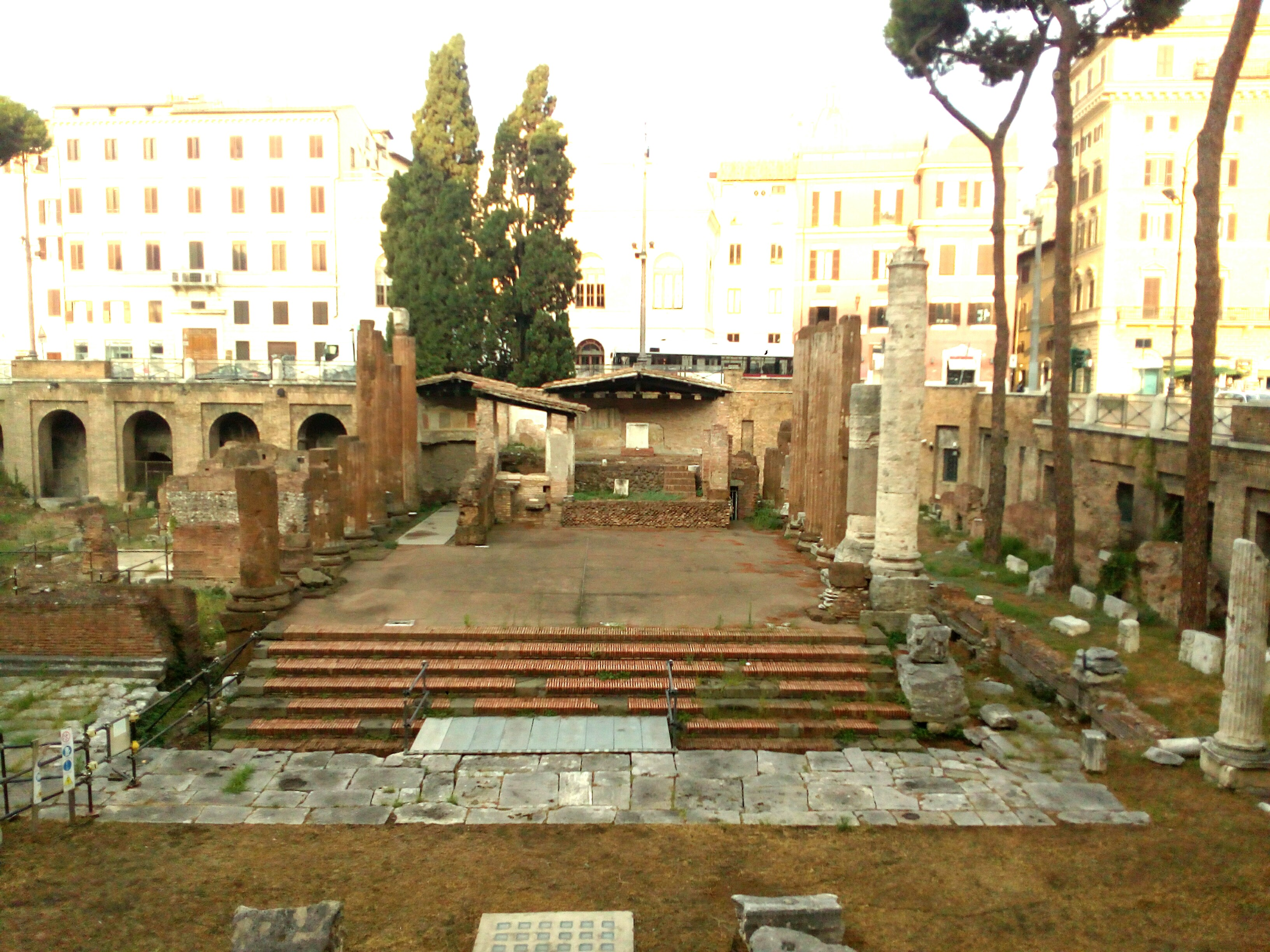
Here, in the photo, one of the temples from the Republican period, built during the 3rd century BC in the sacred complex of Largo Argentina (not far from the Pantheon). This is, in my opinion, one of the best areas of Rome where you can see the cultural, religious and architectural evolution of the Eternal City. Suffice it to know, just to get an idea, that right in this area poor Julius Caesar was assassinated. But today the local tour guide in me wants to point out why this archaeological area is full of useful insights for understanding just how amazing Rome is.
The sacred area of Largo Argentina was enriched, over the centuries, by as many as 4 temple complexes. This one here, of which we see the remains, is labelled with the letter A by archaeologists. It is the second place of worship built in the area and even today there is some doubt as to which deity it was originally dedicated to. Probably the so-called Temple A, originally just over 9 metres wide and a little over 16 metres long, and set on a 4-metre podium, was dedicated to Iuno Curitis, the name that the city of the Falerii took as its eponym. A reminder of an ancient war which at that time saw Rome and this city as bitter enemies. It should also be said that later the temple was embellished and enlarged, eventually becoming completely surrounded by pillars, with six columns on the façade (hexastyle). Note that archaeologists found traces of burning, probably recalling a fierce fire that destroyed the area in the 2nd century BC. One curiosity can be seen towards the back, under that canopy. You can notice some frescoes with a clearly Christian character. Why?
Because, as was common during the Middle Ages, some Roman temples were reused and turned into Christian churches, recycling their function and architecture. A practice that would begin with the consecration of the Pantheon, which took place in AD 609. The church was dedicated to Saint Nicholas in Calcariis, in memory of the fact that that area, rich in limestone, was also used as a quarry to extract and obtain that material. You can therefore understand the incredible historical evolution that this small glimpse of Rome has undergone: from temple to limestone quarry, from church to scattered ruins with a pagan and Christian character. It is certainly not the only example in Rome, but this is one of the most emblematic (if you want to read about a church, still perfectly preserved, built on the remains of a Roman temple, click here). How much can the ruins of a temple tell us, right?